

Why Is Starting a New Role Such a Critical Moment?
Take a moment and think back to your first week at a job. You’re new. Everyone else already knows each other. You’re trying to figure out the team dynamics, what your responsibilities are, what your manager expects from you — everything is unfamiliar. At best, it’s a disorienting experience. At worst, it’s one that can genuinely shake your self-confidence. This time, I want to focus on how you can improve pre-boarding using Vibe Coding, and share what we’re doing on my team.
When we start somewhere new, those first few days have an outsized impact. They shape our confidence, build our sense of competence, and introduce us to the organizational culture. The onboarding process begins the moment we notify a candidate that they’ve been accepted. From that point on, we need to start building their sense of belonging.
So How Can You Improve Pre-Boarding with Vibe Coding?
I recently hired a new team member. On the day she signed her contract, we spoke and agreed on a start date together. We settled on her joining roughly two and a half weeks after signing. Following recommendations from the recruitment team, I set a reminder to reach out to her a week before her start date. The goal was to begin building a connection, check in on how she was feeling, and above all, let her know how excited we were to have her joining us.
The organization I work for provides a structured onboarding framework and support system. It sends out pre-reading materials that explain the vision and values that guide us.
Because I’m a bit addicted to Vibe Coding (I can stop whenever I want! 😉 — and if you haven’t read about it yet, check out Vibe Coding: Building an App Through Conversation with AI), I took the opportunity to do something more. I wanted to create a landing page that would introduce her to the team and the unit in a more personal way. So I built an interactive welcome page using Lovable.
What Features Did It Include?
👯♂️ “Who We Are” — Your Team
This section introduced the team with names, photos, roles, short personal descriptions, and even a clear designation of who her mentor and buddy would be. Why does this matter? Because seeing the faces of your future teammates and learning a little about each person creates a sense of personal connection and reduces anxiety.
🧩 “What We Do” — Your Role
A clear role definition, free of technical jargon — just a simple explanation of what we actually do here. Why does this matter? Because it provides a framework and clarity around goals and professional expectations, and helps the new hire begin forming their own understanding of the role.
📅 What to Expect in Your First Days
This wasn’t a rigid schedule — we all know that onboarding is a dynamic process. Instead, we focused on key milestones: meetings, observation sessions, and visits to other units. Why does this matter? It reduces the element of surprise, creates a sense of certainty, and sets clear expectations. We also built this section as a checklist to allow for progress tracking.
💬 Getting in Touch with Your Manager
This section included contact options for reaching the manager or team members. Why does this matter? It gives the new hire a direct line of communication and makes it clear that there’s always someone to turn to with questions. We also included a link to the team’s WhatsApp group, so she could choose when she felt ready to join.
Of course, we also included information about the organization, a reference to the onboarding kit, and a few other elements — but what mattered most to us was starting to build a personal connection. Every element on that page was carefully chosen to create an experience that fosters a sense of belonging. If you’d like to see what it looked like, I’ve included an image right here 👇.
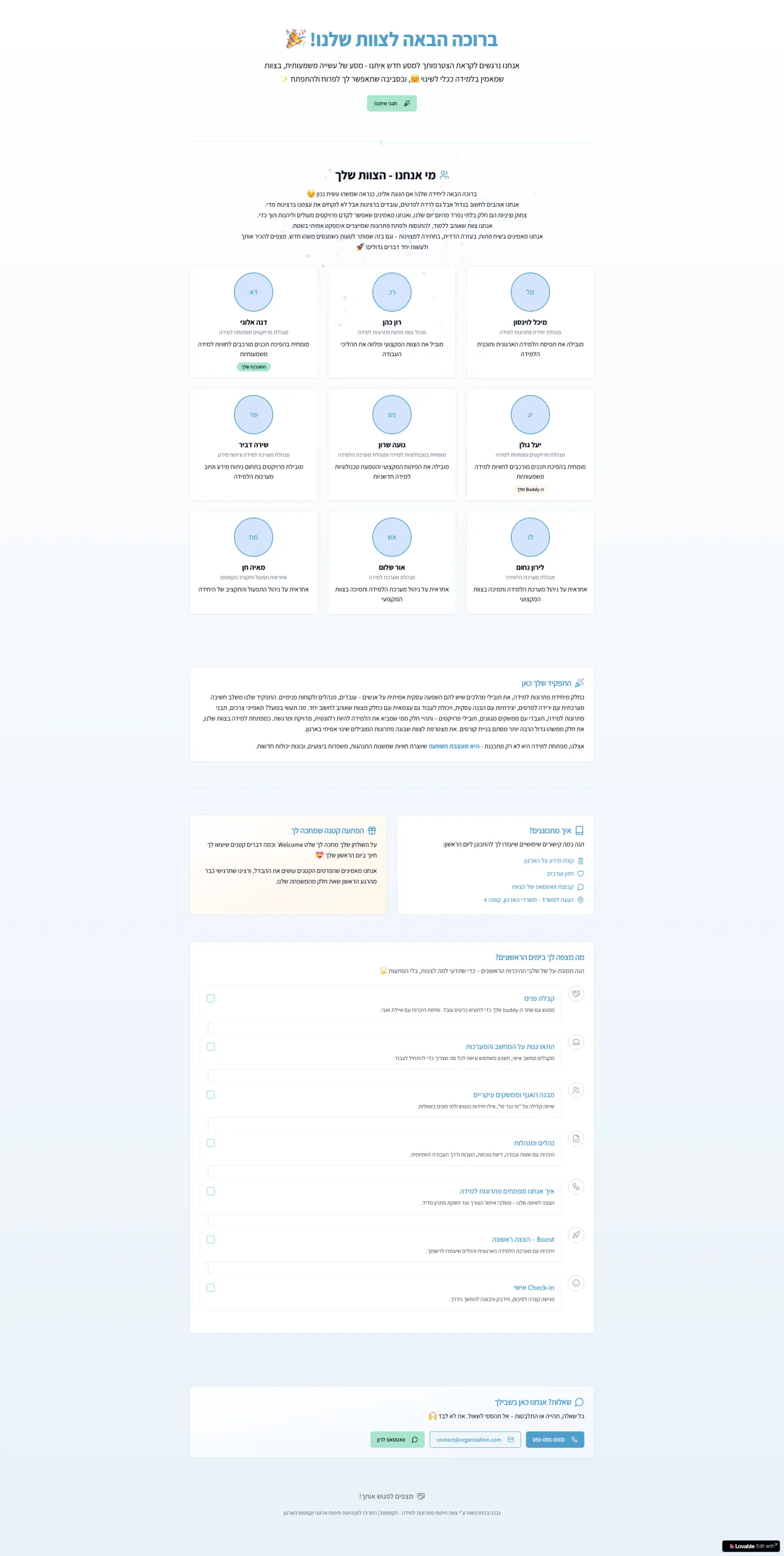
Instead of preparing PDFs or pre-boarding documents, I designed an experience — the way I envisioned it — and simply described the “vibe” of it to a language model and let it bring it to life. This process of intuitive creation is the heart of Vibe Coding. No code, no technical specifications — just a focus on content and experience.
Why Does It Work? And What Did I Learn?
- A personal experience — This was a solution built specifically for the new employee, not some generic template. Managing to make someone smile as they’re being welcomed into a new workplace strengthens their sense of belonging and organizational connection.
- Designing an employee experience, not just a process — The emphasis here was on creating a sense of belonging and addressing feelings like uncertainty or ambiguity that come with joining a new organization.
- Using artificial intelligence — You no longer need to spend a lot of money to bring an idea to life. All it takes is knowing which tools to use and how to use them.
⚠️ It’s worth noting that not everything is perfect. If you’re building complex systems, a bit more technical knowledge is required. Vibe Coding works best when you’re trying to create a relatively simple tool, especially one that’s primarily Front-End based.
If you’re weighing which language model to use to create the requirements document for a system you’re building, I invite you to read: Chain of Thought (CoT) — The Method Behind Reasoning Models 🔗. And if you want to get more out of your prompts, check out: The RICE Framework — The Prompt That Gets You Precise Results 💬.
So, whether you’re in a management role or simply want to welcome someone the right way — pause for a moment and ask yourself: “How would I have wanted to be welcomed?”