

The interface between humans and machines has given rise to a field called ‘prompt engineering’. In essence, this means that in order for the results we extract from a language model to be precise rather than overly generic, we need to sharpen our “query” and provide enough information. In this video we’ll talk about a framework called RICE that will help us get more accurate results from a language model.
Here Are a Few Additional Frameworks
Crafting prompts is a critical skill in our interaction with a language model. If we think about it, the first application we saw for a language model was chat — an environment in which you hold a conversation with the model. This suggests that in order to get results that are good enough and precise enough, you need to engage in more than one interaction with the model.
To shorten the process and ensure that the prompt we write contains enough information for the language model to deliver a valuable result, we can use a variety of frameworks, such as RTF or RISEN.
RTF Framework
RTF is an acronym:
- Role
- Task
- Format
This is perhaps the most well-known and fundamental prompt structure, in which I “assign” the language model a specific role, ask it to carry out a specific task, and define the way I’d like to receive the result.
It looks like this 👇
Act as an expert in [define the role you want the AI to fill]. Create [define the task you want the AI to perform]. Present the result in the form of [the requested format].
And here’s an example 👇
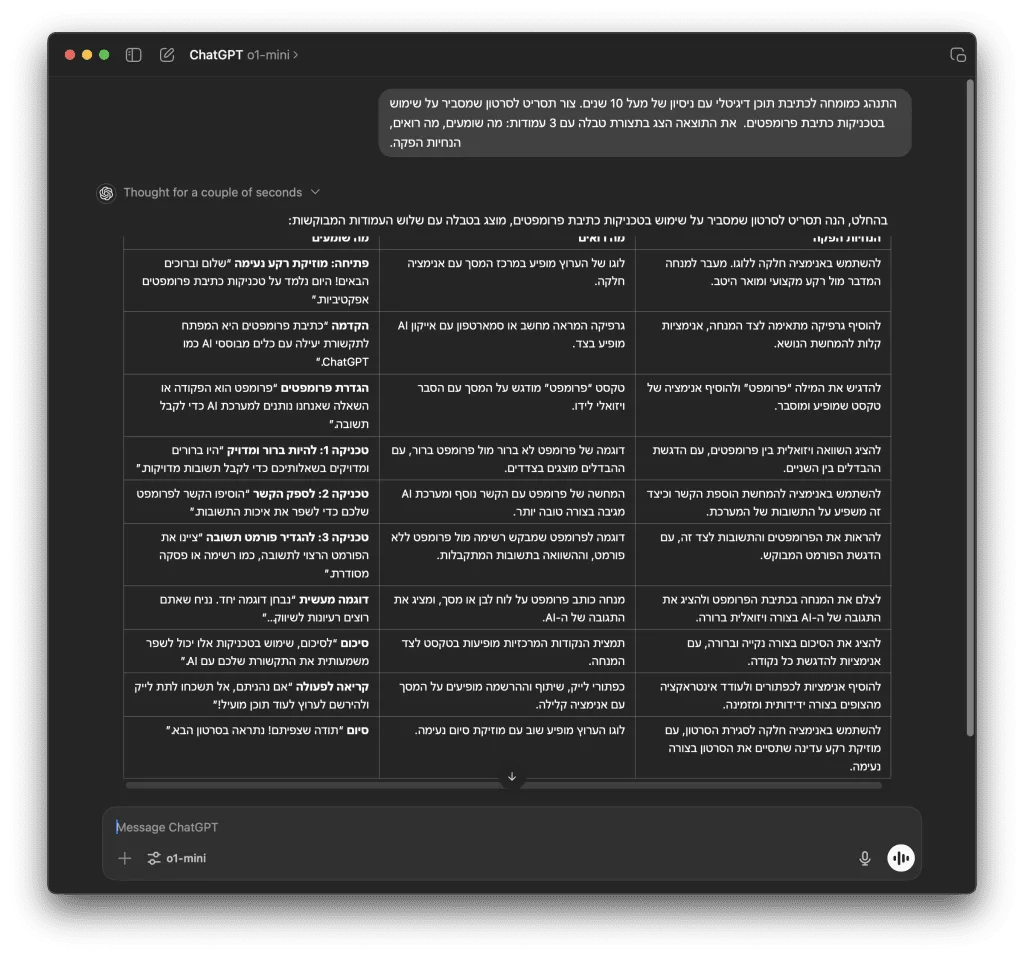
Act as a digital content writing expert with over 10 years of experience. Create a script for a video explaining how to use prompt-writing techniques. Present the result as a table with 3 columns: what is heard, what is seen, production notes.
As you can see, the result I received is far more focused and precise, but it still requires a Human in the Loop to narrow it down to a specific audience (such as people experienced with AI) and to add a personal touch.
RISEN Framework
This too is an acronym:
- Role
- Instructions
- Steps
- End goal
- Narrowing
The key difference in this structure is its pragmatic approach of breaking a single task into sub-tasks, which allows it to handle complex tasks. Another difference is an approach that is more focused on the goal the AI is helping us achieve — naturally, the clearer and more actionable the goal, the more precise the result will be. It looks like this 👇
Role: Act as a digital content creation expert with over 10 years of experience.
Instructions: I want to write a blog post in which I explain to an audience that already knows how to use AI how to use frameworks to write more precise prompts and get better results.
Steps: Break the topic into steps — first explain what a framework is, present examples of different types, write an explanation for each type, and create a comparison table.
End goal: I want to increase exposure to my website and attract new followers.
Narrowing: The post should be written clearly so that even people who are not experienced with language models can understand it. It is important to include demonstrations and possible use cases.
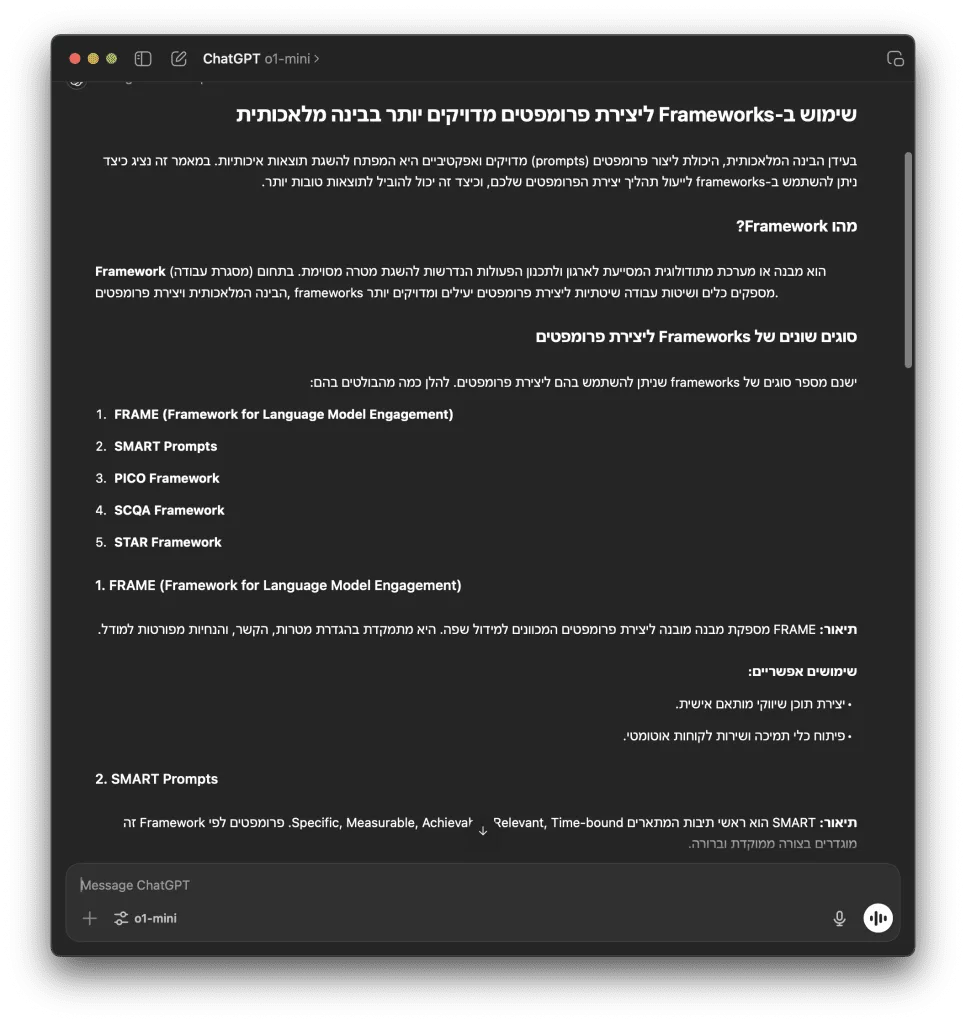
The result we received 👇 This time the result is more detailed and divided into steps, with the inclusion of language designed to increase the blog’s exposure.
Summary
To get good, precise results it is important to refine your prompt throughout the ‘conversation with the model’. If you have a prompt you’re happy with the results of, save it as a meta-prompt and reuse it.
What is Prompt Engineering?
Prompt engineering is a field concerned with formulating precise queries for language models, such as ChatGPT, in order to receive accurate rather than generic results.
Why is it Important to Use Prompt Engineering?
Using prompt engineering correctly allows us to:
Get more precise results – A detailed and clear prompt guides the language model toward producing the desired output.
Save time – Using effective prompts shortens the interaction time with the language model.
Handle complex tasks – Different frameworks allow complex tasks to be broken down into sub-tasks, making it easier for the language model to deliver a high-quality result.
How Can I Improve the Quality of My Prompts?
Use frameworks – They help build structured, precise prompts.
Write clear instructions – The clearer the instructions, the more precise the result.
Use examples – Examples help the platform understand the desired style and content.
Experiment and iterate – Trial and error will help you find the most effective prompts for your needs.