
What Is Automation?
Think of automation like a coffee machine. You press a button that triggers a fixed, pre-defined sequence of actions, and at the end you get your coffee. Automation is a sequence of automatic actions planned in advance and executed the same way every time by a machine or software. Automation can include filling out forms or sending messages and reminders to customers.
When do we use it? In repetitive processes, such as sending an email, organizing files, or updating a customer record in a CRM.
The goal is to streamline and improve the services and products that businesses provide to their customers. Integrating automation into workflows enables faster, higher-quality service with fewer errors. On one hand, it allows businesses to free up time and resources for activities that drive profitability. On the other hand, it allows employees to lead processes that require deep thinking and creativity.
Common tools: Zapier, Make, n8n
The language capabilities of artificial intelligence make it possible to build more complex automations. In the example below, you can see an automation that converts audio files from Zoom meetings into meeting summaries with action items.
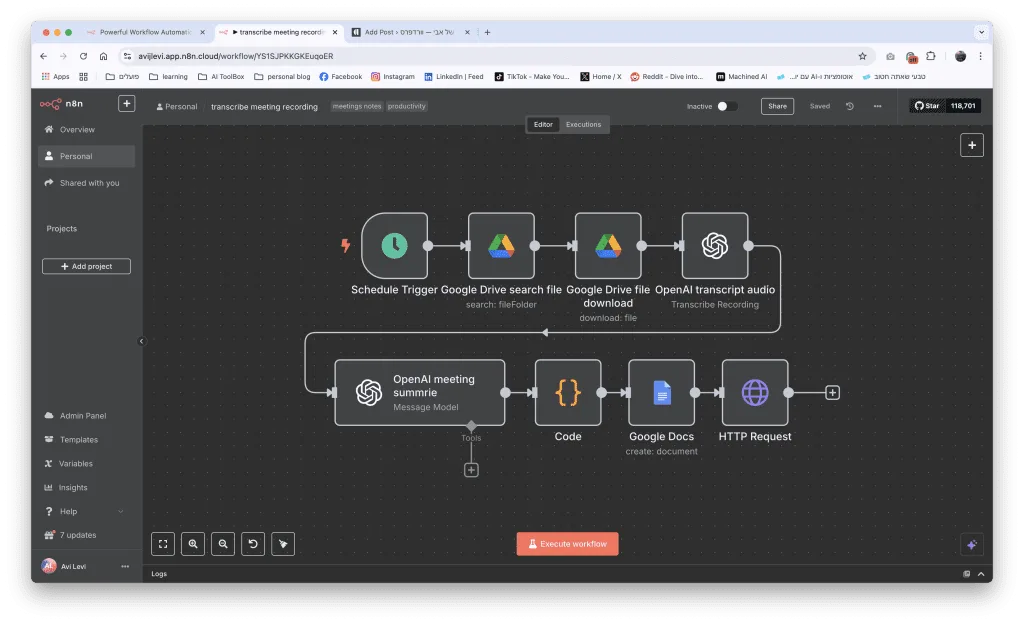
When building an automation, you define what the trigger will be, the sequence of actions from start to finish, and what the output will be. At each step, we work with the data (input and output) that passes between stages.
In this example, I set a time-based trigger that fires once an hour. On each run, the automation checks whether a new audio file has been added to the Drive folder where I store all my meeting audio files. As soon as it detects a new file, it kicks off a chain of actions.
It downloads the file, sends it for transcription (via OpenAI), continues with summarizing the key points and tasks (via ChatGPT), and finally creates a new Docs file in the Meeting Notes folder in Drive.
This way, every meeting I hold is automatically turned into a written summary through a sequence of actions I never had to intervene in — except when I set them up in the first place.
Of course, you can extend this further by adding a step that emails the meeting summary.
Where does it fall short? If something unexpected happens at one of the steps — for example, the file format is not MP3 — the process will stall and won’t continue until I step in and fix it. That is exactly the problem that Agentic Workflow solves.
What Is an Agentic Workflow?
When we move to an Agentic Workflow, we are talking about processes that have a goal, and the “agent” is the one making decisions within that process. The agent translates the goal into steps and decides which tools to activate at each stage.
In the example below 👇, you can see an automation triggered via a chat interface. That trigger activates an “agent” that independently decides which tools to use based on the situation — or more precisely, based on the context.
In this case, I built an agent that “knows” the content on my website. When a user asks a question about something I have published, the agent searches for the answer on the site. If no answer is found there, the agent provides information from its general training knowledge and sends me an email requesting that I add the relevant content to the site.
Get it? The agent decides on its own which tool to activate and when to use it.
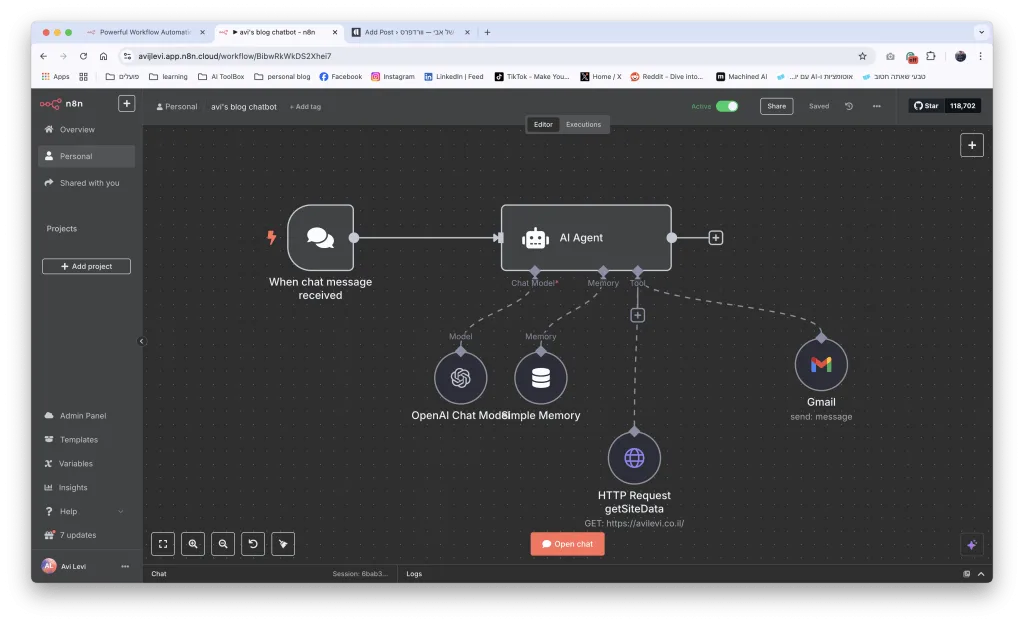
The agent is the core of the automation, and it is typically connected to three key components:
-
Brain – A language model, in this case ChatGPT 4o. The model translates the goal we are trying to achieve into tasks and determines which tools to use for each one, while prioritizing actions according to context.
-
Memory – Without memory, the agent effectively “forgets” everything at each step. It starts each task from scratch instead of building on the results of previous tasks. In other words, the agent becomes context-free and incapable of learning across steps.
-
Tools – To reach its goal, the agent needs to activate tools. It essentially steps outside the chat ecosystem and, using language, generates instructions that activate tools such as email, image generation, code development, or file updates.
The agent uses its “brain” to decide which tools to activate and at which stage. As you can see, the process becomes iterative rather than linear, which means we no longer need to anticipate every possible scenario — the agent itself figures out what the right action is at each step. Incidentally, some agents correct errors made by other agents and improve automation processes over time.
This Is Intelligent Automation
The shift from Automation Workflow to Agentic Workflow is not merely a technical one. It is the difference between systems that operate only according to a pre-defined process — and only when that process runs without a hitch — and systems that understand their goal, make decisions about how to act, and continuously improve themselves.
Would you like me to walk through the process of building an agent like this step by step? Share your thoughts in the comments or send me an email 👇