

To understand how large language models (LLMs) work, it’s important to understand the mechanisms that drive them. In this video we explain what tokens are, how they affect your conversations with a language model like GPT, what a context window is, and how to work with tokens intelligently 👇📺.
If you’re looking for a rule of thumb, one token is generally equal to 4 characters of text — roughly a quarter of a word (so 100 tokens ≈ 75 words). You can check how many tokens your own text is worth and read more about it directly on the OpenAI website. Incidentally, this video is equivalent to 668 tokens — and it looks like this 👇
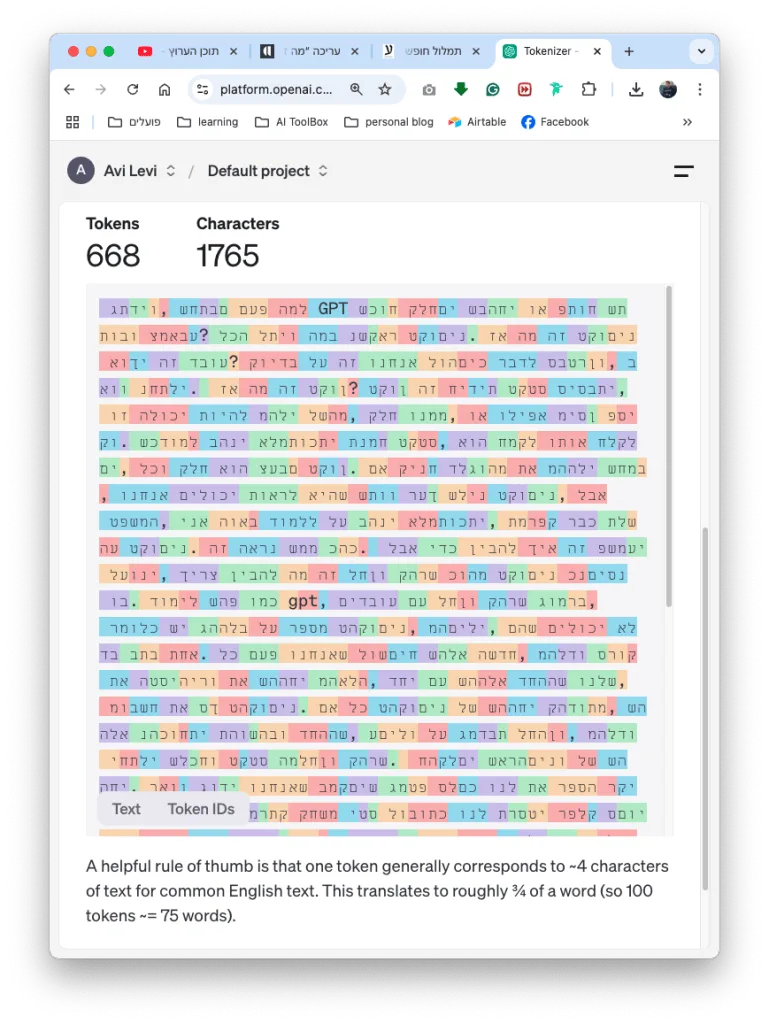
Why Do Tokens Matter in Day-to-Day AI Work?
Tokens directly affect what the model “remembers” within a conversation, how much information you can fit into a prompt, and how accurate the response will be. If you feed in too much irrelevant information, the context window fills up and the model struggles to identify what actually matters. If you provide too little information, it’s forced to fill in the gaps on its own.
This is why working effectively with an LLM isn’t just about writing a well-crafted question — it’s also about managing context: deciding what goes in, what stays out, and what should become a persistent document. This connects directly to managing the context window in Claude Code and the way you work with AI agents on larger projects.
When working with long documents, tokens become a genuine planning consideration. Sometimes it’s better to summarize a document before bringing it into a conversation; sometimes it makes sense to break a task into stages; and sometimes the right move is to store recurring knowledge in a dedicated file rather than pasting it in fresh every time. This is one of the reasons context management has become a foundational skill in AI work.
In practice, someone who understands tokens knows how to plan a better conversation, cut out the noise, and get more precise answers from the model.