

We tend to think about learning processes — and the adoption of tools, systems, and organizational changes — in classic terms like “training.” It starts with a needs analysis, we build some polished presentation, schedule a session in the calendar, or send out an e-learning module. But in an era of daily transformation, we need to rethink our methods and workflows, and recognize that traditional approaches simply no longer cut it. Our workflows need to be more efficient and significantly faster — and I’ll say it… brace yourselves… even at the expense of quality 💣.
I want to start with a small confession.
A few days ago I fell into the very trap I always preach against. Someone in the organization reached out to us to create a short training video about a tool we’re rolling out. The video was going to be shown at a large internal conference in front of a lot of people.
My immediate thought 💭: “We need After Effects — that’s two weeks of work with a vendor. There’s no way this will be ready in time.”
But then I remembered that a while back I had discovered Remotion and used it to create a promotion video for one of the products I’m developing in my side projects. (I’ve attached the video below 👇 — if you’re curious, take a look; if not, just scroll on and keep reading.)
And then it hit me: “Why not try building the conference video without After Effects, using Remotion?” Within a few hours we had a 90-second video complete with screen demonstrations, graphics, animations, voiceover, and music. No After Effects, no fuss — just Short-Form instructional content designed to lead learners straight into the learning journey inside the LMS or wherever it lives.
That’s the confession. It was also a lesson for myself: I can’t preach about changing your mindset without actually changing my own.
What is Short-Form Content?

Short-Form Content is a term that comes from social media and refers to brief content — typically video — running 30 to 90 seconds, built around a single sharp, clear message. It’s content designed to cut through the attention deficit we’ve all developed and be compelling enough to make us stop scrolling through our feeds.
Why does it work so well on our brains?
- Cognitive Load Optimization — it aligns with our attention mechanisms by minimizing the cognitive load we experience.
- The Dopaminergic Feedback Loop — it creates an immediate reward cycle, releasing dopamine in the brain and generating a positive experience.
- Workflow Integration — it fits naturally into our daily routines.
- Authenticity & Trust — it works through mechanisms of identification, authenticity, and building genuine trust between people.
How does this relate to learning?
Our field is multidisciplinary — we borrow techniques from different content domains to design learning solutions. Just as we create personas to define a target audience (a technique from UX), we can borrow techniques from marketing to encourage engagement in the learning process.
If you think about it, Short-Form Content is very similar to Micro-Learning.
Both involve short units that can be woven into the flow of work, enabling Just-In-Time Learning. And because they’re simple to produce, you can create many of them and build Spaced Repetition processes to combat the forgetting curve.
You can think of it as a marketing funnel in which Short-Form Learning plays several roles along the way. Just like in a marketing funnel, our goal is to engage the target audience (the learners) and guide them through the “funnel” until they take the desired action. Here is a diagram that illustrates the role of Short-Form Learning in organizational learning processes, viewed through the lens of a Marketing Funnel.
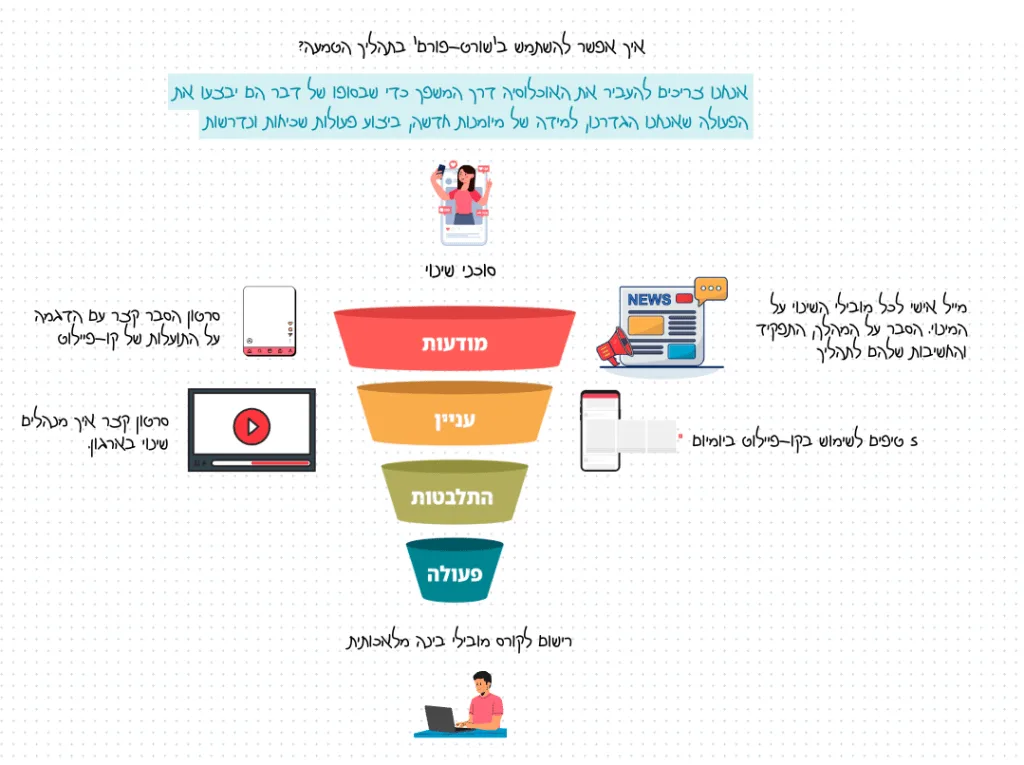
A quick guide: how to build a Learning Funnel in 5 minutes
Here’s how to apply this model, exactly as shown in the diagram:
1. Define the “Conversion” (Action) — What is the final action you want learners to take? In the diagram: enrolling in an AI Leaders course. If there’s no clear action at the end, it’s not a funnel — it’s just “general awareness.”
2. Create the Hook (Awareness & Interest) — Don’t send a syllabus. Send a “crash.” A short, personal email to your target audience (“You’ve been selected to…”) paired with a 30–45 second short-form video. Tip: Film yourself on your phone showing one thing you can do in Copilot that saves you an hour a day. No editing, no elevator music. Authenticity beats production value every time.
3. Handle the Objections (Consideration) — This is where most people drop off because “they don’t have time.” Send a “5 tips in 5 days” series (Nudges) — one short tip per day, each taking 30 seconds. This builds confidence with the tool before learners ever set foot in a classroom.
4. Engage the Support Layer (Manager Buy-In) — A short video for managers. This is critical. A manager who doesn’t understand why their employee is “wasting time” on AI will block the funnel entirely. The message should be: “Here’s what your team will look like the day after.”
5. Close the Sale (CTA) — Every piece of content (at the end of the video, at the bottom of the email, at the end of the tip) must include one prominent link: “I want to be a leader — register here.” Use the tools you already have: email, a simple registration form (Forms), and a phone screen recording. This funnel is built to generate movement and adoption, not to win an Oscar.
What should you pay attention to when creating video for Short-Form Learning?
🪝 The Hook
The first 3–5 seconds, in which you want to “capture” learners’ attention and overcome their impulse to abandon the content or move on. Here you present a problem the viewer would want to solve, or a promise that something is about to get better. The hook needs strong textual and visual emphasis. For example: “3 new skills that will make you a leader in…” (Hook types: list, benefit, problem-solution.)
🫀 The Body
5–75 seconds in which you deliver the core value you committed to in the hook. If you promised to solve a problem, present the solution. The key here is to cut straight to the point and focus on immediate, genuine value. Remember to simplify the message and use straightforward mental frameworks such as the Rule of Three or an “if → then” structure.
🗣️ The Call to Action (CTA)
A strong close is the stage where you invite viewers to take some kind of action — try something, learn something more, respond, or anything else that keeps them engaged with the content. For example: “In your next meeting, try this method and see if…”
What do we NOT want to import from social media?
- The Illusion of Knowledge — a feeling of shallow understanding without real depth. We don’t want to fall into superficiality. On social platforms, virality sometimes comes at the expense of accuracy, so it’s important that we remain precise and honest.
- The Infinite Scroll Mechanism — an attention trap that undermines productivity. On social media, the mechanism is designed to keep us passive and online; inside an organization, we want to encourage application and action.
- Fake Authenticity — forced imitation of trends that don’t match the organization’s culture or language.
- Overly Frenetic Editing — sensory overload that interferes with learning. It’s important not to create a stimulus overload that pulls focus away from the subject itself.
In short
Short-Form Content is not just a change in video format — it’s a mindset shift for us as learning professionals. We are no longer just instructional designers; we are becoming product managers and marketers of knowledge and learning processes. We have to move faster, deliver immediate value, and improve on the fly.
Not every project requires a professional production and a massive budget. Pick up your phone, open a tool like Remotion (or simply film yourself), and start building your funnel. In the end, our real measure of success is not how good the video looks, but how many people actually moved through the funnel and started using the new tool in the real world.