

Why Would You Even Need to Outsource Your Brain?!
One of the hardest things to deal with in recent years is the sheer pace at which new developments and capabilities are entering our lives, day after day. We are in the middle of a “storm” that is affecting every single part of how we live.
It all started with the “Big Bang” — sometime in November 2022 — when OpenAI turned generative artificial intelligence into a technology accessible to every one of us, and it has only improved since. This technology, which just a few years ago was a chatbot interface you could ask questions and get answers from instead of search results, has evolved to the point where anyone can build a product and ship it without knowing how to code, and with almost no technical background.
The impact of this shift on our lives is staggering. It demands that we explore and understand how AI models work, what applications can be built with them, which products lead each category (image generation, video, software development, and more), and that we stay current in a field that is fundamentally reshaping the job market and the employment model for each and every one of us.
Now, I want to pause and share a few things about myself. I’m a curious person, I overthink, I find it very hard to let things go, and I have a tendency toward anxiety (“we love you, Avi”). You’re probably wondering why I’m telling you this — or maybe even considering dropping a therapist’s number in the comments. I’m already in therapy, so I’m fine :). What I’m trying to say is that the need to stay current, to track new changes and capabilities, to explore them in depth and experiment with them, puts me in a state where I simply can’t keep up. I find myself consuming enormous amounts of content — blogs, YouTube, podcasts, and other media — and it leaves me with a flood of ideas, tools I’d like to try, products I’d like to build, management techniques and methods I’d like to implement with my team at work, and I never get to all of it. There’s something genuinely discouraging about realizing just how hard it is to keep up with the pace, so I retreat to the PlayStation.
I want to share a method I’ve been experimenting with lately — one that lets me “outsource” my brain to help me keep up. Some of you have probably heard of it. It’s called a “Second Brain.”
Research shows we spend nearly 8 hours a day on average consuming digital content. We spend almost two and a half hours every day on social media and watch around 100 minutes of video per day. If you think about it, work or creation looks something like this:
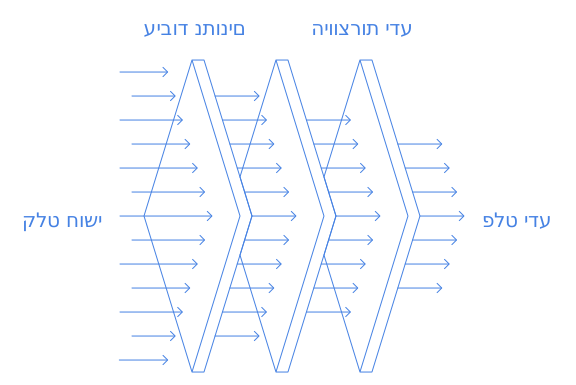
Information input, senses, interaction 📥 — Processing and analysis of input, information, and knowledge ⚙️ — Output of deliverables, processes, and conclusions 📤
This state causes our brains to receive enormous amounts of information and process vast quantities of data, generating thoughts, ideas, and directions for action — things we tend to tell ourselves, “That’s a great idea, I’ll remember it and try to implement it.”
Honestly, how many of those ideas do you actually follow through on?
So the obvious solution is one of the oldest and most effective ones: write it down. Simply write down your thoughts or ideas the moment they appear. You can use a notes app on your phone and create a pinned note where you “dump” all your ideas, thoughts, inspiration, and plans. That way you build a personal knowledge base you can actually search.
By the way, one of the tools I’ve been using a lot lately — and even using to create my own podcasts — is Google’s NotebookLM, which genuinely lets you turn your own thoughts into a conversation.
How Do You Build a Second Brain?
It’s a four-step technique that spells out the word CODE:
-
Capture – A lot of our mental bandwidth gets “wasted” on collecting information and trying to remember it. If instead we captured that information into a notebook, a notes app, or any other tool, we’d free up resources for higher-order thinking, creativity, and problem-solving — and we’d be able to return to those thoughts in the future. So what do you do? A calendar and a task list, so you no longer need to remember what you need to do, what you want to explore, what you want to experiment with — it’s all simply written down. For example, I have a note where I jot down thoughts sparked by something I’ve read, ideas I’d like to implement, tools I want to check out and try, and tasks I need to complete. Here are a few tools that can help you capture your thoughts: Notion, Notes, ClickUp.
-
Organise – Once you’ve captured your thoughts, ideas, and tasks, the next step is to organise them. The recommendation here is to sort information not by topic, but by how you intend to use or apply it. For example, if you watched a YouTube video that gave you an idea for a digital product, add it to your list of products you want to build. If you read a book that made you think of an exercise you’d like to do with your team, add it to your list of team activities — and so on. You get the idea: organise by project, not by subject.
-
Distill – After capturing and organising your information and ideas, you’re still left with a lot of material. So highlight the key points within the content you’ve collected. This way you’re flagging the things that carry the most significance for you — for instance, a specific product that could transform an exhausting workflow, or an idea you’ve developed and want to explore further.
-
Express – The final step is to express yourself — to show the world, your colleagues, your partners the work you’ve done, to share your knowledge and your ideas. By doing this you’re not only putting them to use to create something new, but also refining them, adapting them, and shaping them for your own needs or for the deliverables you need to produce. A presentation you created on a topic you researched, or a blog post — exactly like this one.
All the steps I’ve described here allow you to “outsource” mental processes in order to free up space for what truly matters: taking care of yourself, creating, and managing the flood of information — while staying informed without losing your sanity.
To close, so you can see just how much everything written here also played out in the writing of this very blog post: the idea for the post came from a YouTube video by Ali Abdaal, whom I follow closely. I did the research with Perplexity, which helped me understand the methods in depth and surface research-backed data. I created the graphics for the written post using Napkin AI. I previously tried building my Second Brain in Notion. And the accompanying podcast — which includes additional episodes reflecting my own ideas and thoughts — was created using NotebookLM.