

TL;DR
At the beginning of November I returned to teaching — this time on a digital learning development course at HIT. It quickly became clear that I needed to practice what I preach and design an effective learning journey.
Each session is divided into three parts: thirty minutes of self-paced video learning, thirty minutes of live discussion on Zoom, and thirty minutes of hands-on practice with real-world tasks that allow experimentation and, along the way, portfolio building.
At the end of every session there is a short quiz in Moodle. The score does not count toward the final grade — it serves as a sensor. We analyze the responses with AI to identify gaps, pinpoint unclear concepts, and determine where we need to sharpen our own teaching.
After each session we analyze the transcript and add “deep-dive units” on topics that surfaced in discussion — such as Bloom’s Taxonomy, Kirkpatrick, or ROI.
My central insight is that a good course is a living, adaptive process — one that aligns with how the brain works through repetition, memory, processing, and application. We need to build the sensors that allow us to steer the journey, and AI helps us make that process more experiential, precise, and clear.
I Switched Roles — From Learning Solutions Developer to Lecturer
At the beginning of November something happened that I hadn’t done in a long time: I went back to teaching. I moved from developing courses, training programs, and learning solutions for employees to the lecturer’s side of the room, and began teaching second-year students at the Holon Institute of Technology on a digital learning development course — together with Merav, who also works with me at Campus Po’alim.
The experience forces me to put into practice the things I talk about and to ask myself: what does a “healthy” course look like — one that generates a sustained, effective learning process and genuinely prepares students for the working world?
The Three-Part Method — Named After Yanay Zaguri
The course runs on Zoom: one semester with two academic hours per session and a second semester with three hours per session. To prevent it from becoming yet another Zoom class where everyone is half-present, each session is divided into three parts:
- Thirty minutes asynchronous — Students do not join Zoom straight away. Instead, they watch a pre-recorded video we prepared in advance, covering the session’s core topic. For example: what marker videos are, why they matter, and how to approach creating them professionally.
- Thirty minutes of live discussion on Zoom — After they have already seen the content, we meet for a conversation. Not a lecture — a conversation. We ask questions, challenge assumptions, connect ideas to real-world examples, and compare what they are learning with content from other courses.
- Thirty minutes of hands-on work — The final thirty minutes are dedicated to completing a task that forms part of their course submissions. The idea is not to pile on another homework assignment, but to let them make progress within the session itself, with our guidance.
This structure forces us to think carefully about what must be “said in class,” what can be delivered in a pre-recorded video, and which parts must involve direct experience.
Learning Sensors — Mini Quizzes at the End of Each Session
At the end of every session, students find a short quiz in Moodle — three to five questions. The score is intended for the students themselves and does not count toward the final course grade. What matters to us is two things:
- That students can verify for themselves whether they understood the key concepts and ideas from the session.
- Whether we need to refine or change anything about how we taught.
The point is clear: this is a sensor, not a test. We are not looking for “who is the weakest student.” We are looking for:
- Which questions most of the class got wrong
- Whether the error stems from question wording, confusion between concepts, or a genuine lack of understanding
- Whether there are recurring patterns of confusion around central concepts and terms
Where AI Enters the Picture
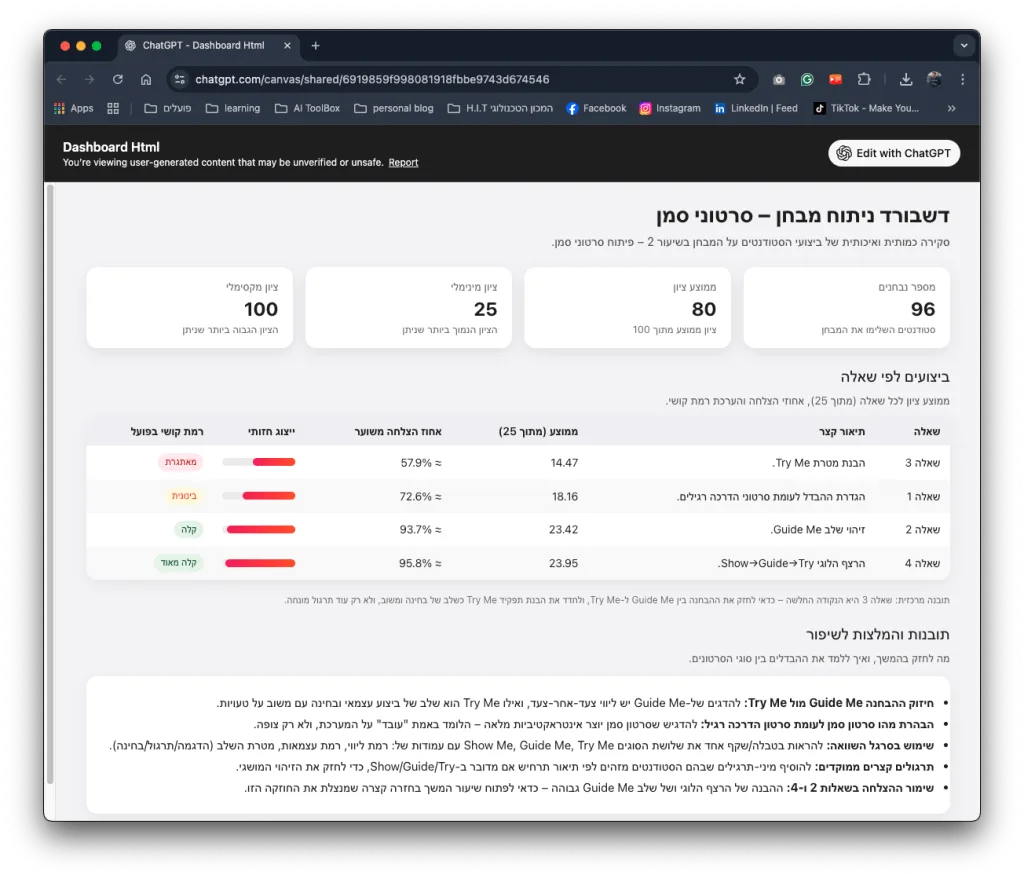
We download the quiz results and feed them into an AI model to identify:
- Which questions were the most problematic
- The distribution of responses across the distractors
- What can be inferred about the nature of the confusion
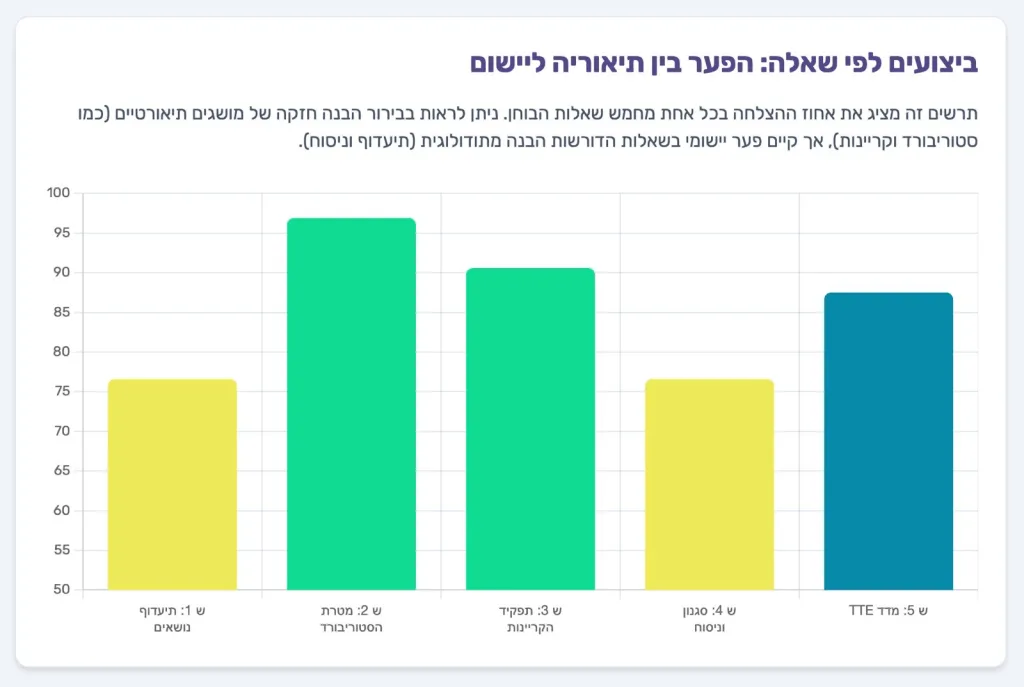
Instead of spending an hour in a spreadsheet, AI helps us quickly get to questions like:
- “Did they understand the difference between a ‘Guide Me’ marker video and a ‘Try Me’ one?”
- “Do they understand how marker videos improve Time to Efficiency?”
Anyone who has read my work before knows I enjoy integrating AI into learning process analysis and data-driven decision-making — and this is another classic case of exactly that. In this instance, Merav, the master of process optimization, analyzed the quiz and built a GPT dashboard that looks like this 👇
When a Student’s Question Becomes Three Mini-Lessons
One of the most powerful experiences I have had so far was a session on marker videos and their connection to Time to Efficiency.
In the middle of the discussion, one of the students asked: “But how do you actually measure effectiveness? How do you know a video like that really shortened the time?”
That question opened a door to a conversation about defining objectives, Bloom’s Taxonomy, the Kirkpatrick Model, and learning ROI. It may not be part of the syllabus, but it is absolutely part of the learning process — the ability to apply what they have learned in a new context of product development.
That is where I understood something important: when you make room for questions, the course deepens toward the most important places — not just what we planned in the slide deck.
The “Deep-Dive Zone” in the Course Environment on Moodle
To ensure these conversations do not simply dissolve into the air, I decided after that session to create a dedicated section in the course environment where we consolidate extensions and materials on topics that arose during the session — even if they are not the “official topic.” For example:
- A short HTML page on Bloom’s Taxonomy with examples from the world of learning development
- A plain-language summary of the Kirkpatrick Model and how to think about it in the projects they will build
- An accessible explanation of learning ROI, without turning it into a finance lesson
- A page on writing conventions in technical writing
- An ADDIE-based question guide that can be used in any learning development project
In effect, something emerged here that sits between an “extension library” and a “follow-up” to questions that came up. Students see that their questions are translated into content, and we as lecturers create additional value.
What This Course Is Teaching Me (Again)
We are only at the beginning, but I am already distilling a few principles I want to carry forward:
- Learning is a process, not an event. The continuity between sessions, the consistent structure, and the short end-of-session quizzes create a system and an ongoing learning process.
- Assessment is a learning tool. When a Moodle quiz does not count toward the final grade, it can be used as a carrot rather than a stick.
- Data + AI = less intuition, more insight. Instead of “I think they didn’t understand,” we have data showing exactly where comprehension drops and what needs to be sharpened.
- Students’ questions are raw material for the next piece of content. We used discussions to open a deep-dive channel and gave space to topics raised by the students themselves.
- Respect for learners’ time. The fact that they are students does not mean they have unlimited time. Working within the session is both a pedagogical and a human decision — and we owe it to Yanay.
What’s Next?
This course is still in progress — and so am I. I expect that by the end of the semester I will have many more insights about what worked, what did not, and how to design digital courses for a generation that already lives online. But if I had to sum up the current moment in a single sentence, it would probably be:
Teaching digital learning development is not just about teaching tools — it is about practicing together what smart, adaptive, data-driven learning actually looks like.
And Now, the Thank-Yous

I always dreamed of being the lead singer in a rock band. If you also had a Discman and spent a lot of time at the music store flipping through liner notes, you probably know that at the end of the booklet tucked inside the CD case there were always acknowledgements. I may never be a rock star, but I can absolutely add my own thank-yous here 😉.
I want to say a huge thank you to Prof. Gila Kurtz, Dean of the Faculty, who combines uncompromising professionalism with exceptional interpersonal warmth. Thank you to Dr. Dan Kohen-Vacs, Head of the undergraduate department, who leads the program and attends to every detail. A huge thank you to the great Yanay Zaguri, Head of the Learning Development cluster, for everything he teaches me every single day. To Merav Taler Shadi — co-lecturer on the course and my work buddy — the one who knows how to play ping-pong with me and make me think. And to Ayelet Cohen Bereznitsky, Head of the Learning Solutions unit at Po’alim and my manager, who makes a point of teaching me listening, care, and empathy — without ever compromising on professionalism — and who manages to draw out of everyone far more than they knew they had. I genuinely feel lucky to be doing what I love, and to have the opportunity to be part of shaping the industry of learning solutions developers inside organizations.
That’s it — end-of-album credits. And if you play this backwards, you’ll hear the devil! 😈